From Countryside to City: My Journey and Growth in Japan

Hi guys! Just want to update you. I have been so busy lately that I haven't had the time to update. I plan on posting more in the future. So here's a recap and teaser.

The Journey So Far

Over the past few years, "Silak Randomness" has chronicled my adventures and experiences as a language student in Japan. This blog has been a platform for sharing insights, offering advice, and documenting the highs and lows of living abroad. From cultural tips to financial advice, we've covered a lot of ground together.

Cultural Insights

One of the most enriching aspects of my time in Japan has been understanding and embracing the concept of "omoiyari" (consideration for others). This cultural cornerstone has profoundly influenced how I interact with others and navigate daily life. Learning about and practicing these societal norms has provided a deeper appreciation for Japanese culture.

Financial Management

Managing finances as a student abroad is a crucial skill, and it's something I've shared extensively on this blog. From the initial costs of moving to Japan to monthly budgeting and strategies for sending money home, these financial insights have been invaluable. The practical advice on balancing part-time work with studies has helped many of you navigate similar challenges.

Work Experiences

Working part-time in Japan has been a significant part of my journey. The stories and tips about finding and excelling in part-time jobs have resonated with many readers. Whether it's the first part-time job experience or the nuances of working within Japanese labor norms, these posts have provided practical guidance and support.

Career Transition

Recently, my career has taken exciting turns. I transitioned from an Assistant Language Teacher (ALT) to a direct hire teacher, and now, I am proud to share that I am a science teacher. Each role brought unique challenges and learning experiences, which I plan to chronicle in future posts. These transitions have not only advanced my career but also deepened my understanding of Japan's educational landscape.

Personal Growth and Relocation

Living in Japan has been transformative. It's not just about learning the language or understanding the culture but also about personal growth. The challenges and triumphs of daily life have taught resilience, adaptability, and a broader perspective on life. From cooking my first gyoza to navigating social norms, every experience has contributed to personal development.

Additionally, my journey has seen a significant geographical shift. I started in the countryside, immersing myself in the serene and traditional aspects of Japan. Now, I am transitioning to Tokyo, a move that promises new adventures and experiences in the bustling heart of Japan.

Future Directions

Looking ahead, there are many exciting topics to explore. Advanced language learning techniques, transitioning from student life to a professional career in Japan, and travel diaries featuring hidden gems and popular destinations are just a few areas I'm eager to delve into. These future posts aim to provide even more value and insights for readers at different stages of their journey.

Closing Thoughts

Reflecting on the past year and beyond, it's clear that this journey has been one of continuous learning and growth. The support and engagement from readers have been incredible, and I'm excited to continue sharing and learning together. Stay tuned for more updates and stories as we embark on new adventures.

Study in Japan: How Much Will It Cost Me Initially?

 In my previous post, I described the process of coming to Japan as a Japanese language student. Now that you have an idea of the "How  to?", let's now talk about the "How much?"


100,000 Philippine Peso bundles of 1000 peso bills Silak Randomness
Will this be enough?


Education, no matter where you are in the world, is expensive. Even more so when you are aiming to study abroad. Studying in Europe averages about 20,000 USD in tuition fees, plus about 4,000 USD for living costs (food, utilities, phone, transportation, etc) per semester. Studying in Japan is no different. 

In a glance, let me give you a simple breakdown as to how much you will need to initially prepare to come to study in Japan.

Tuition Fees

Yearly, language school tuition fees alone will cost about 700,000 yen. The cost will vary from school to school and the length of the program you choose. Take note that this amount does not include dormitory fees yet.

Depending on where you decide to study in Japan, costs do vary from place to place, as well as the size of the school. Most established schools tend to cost more because they are usually located in major cities like Tokyo, Kyoto, and Osaka. 

In my school, Oarai International Exchange Academy (大洗国際交流アカデミー), there are only two programs available: 1.5-year and 2-year courses that cost 940,000 yen and 1,230,000 yen respectively.  *The English version of the website seems outdated and is showing 4 courses, but confirming with the owner, there are only two programs available.

Depending on the school you apply for, you will be required to pay part of your tuition up front. Some schools, they require a year's worth of tuition paid initially. For some, 6 month's worth. 

Initial Tuition Cost: 250,000 yen to 850,000 yen depending on the school.


students walking to school to Oarai International Exchange Academy Silak Randomness
Walking to school saves costs

Dormitory Costs

Most language schools offer dormitories or at least will arrange accommodations for you. Compared to tuition fees, dormitory costs vary widely. Initially, a deposit will be required which can be returned depending on the state of the dormitory by the time you leave. When you leave, there will also be a cleaning cost that usually will be covered by the deposit. 

Initial deposit cost: 100,000 yen to 250,000 yen. *Some schools tuck this into the tuition costs so be sure to ask the school whether this will be paid separately.


School Dormitories
These are typically shared rooms. There will always be a toilet and bath for each room but the laundry and kitchen may sometimes be shared.
Price range: In major cities, the price ranges from 20,000 yen to 60,000 yen a month. For smaller cities, it is a bit cheaper ranging from 15,000 yen to about 40,000 yen a month. 


Japanese style bedroom with a large window
Typical dorm room


Private Renting
For those students who prefer to rent their own, it is possible to find your own accommodation. This will usually be for those who are accustomed to a certain way of life and have more spending power. Rent will depend on the location, size, and accessibility of the apartment. 
Price range: Anywhere from 30,000 yen to 100,000 yen a month.

Homestay (Relatives)
Some students prefer to study in a school in the area where their relatives stay. In this case, schools usually allow students to opt to stay with relatives. This would usually prove to be the most cost-effective as relatives tend to charge less (sometimes free) for their stay.
Price range: Depends on your agreement

Cost of Living

When studying abroad, you will have to take every little cost into consideration. When you live at home, you rarely have to worry about food when you get home because the fridge is always accessible. When you get to Japan as a Japanese language student, you can work for 28 hours a week so you will have spending-money but it is advisable to bring two months' worth of food, utilities, and other allowances when you first come to study in Japan. 


Food allowance: 20,000 to 40,000 yen (depending on how lavishly you eat)
Utilities: 30,000 yen to 50,000 yen (depending on what season it is when you arrive)
New phone plan with a new budget phone: 35,000 yen 
Initial health insurance premium payment: 16,000-18,000 yen

Initial budget (two months worth) Total: 125,000 yen


Food
The average cost for a bento box in Japan is about 500 yen. A bento comes complete with rice, a meat dish, and vegetable side dishes. If you are in a pinch, you can opt to buy an onigiri (riceball) instead. They cost about 100 yen apiece. Cup noodles are also available at about 100 yen. You can save the most if you cook at home and bring your own bento (packed lunch). 
Restaurant meals will usually cost you about 1500 yen for a decent set meal.
Price range: Depending on how picky you are with food, a budget of 10,000 yen should suffice. If you are a big eater or if you prefer eating out, set aside a bigger budget.
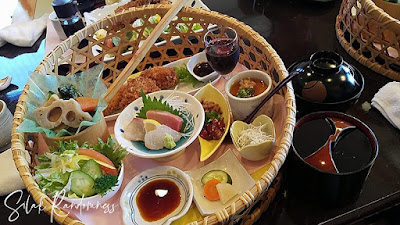
Japanese style sashimi set meal with miso soup in Oarai Silak Randomness
Beautiful Japanese-style set meal

Utilities
Basic utilities are electricity, water, and gas. Utility costs vary per season and hands down, winter is the most expensive. On top of these, you also have internet fees and if you drive a car, you will also have to pay a monthly parking space fee.

Price range: Peak season (aka winter and summer) basic utilities can cost up to 25,000 yen a month. On off-peak seasons you can safely allot 15,000 yen a month. Internet fee averages at 5,000 a month (if you have your own connection) and parking spaces cost about 4,000 yen a month.

Phone
If you have a current iPhone (from the last two years), chances are, all you will need to do is to update your country setting and you are all set. If you're using android, your phone might work with some networks, but it really depends. If you want to check if your phone will work you can use this website. Personally, I think that getting a phone with a plan works the best for Japanese language students because the phone will be tailored to Japanese apps and the provider itself. The cheapest phone plan you can get is around 3,500 yen a month for about 1GB of data. Phone providers also charge a processing fee of about 3,500 yen which will be charged to your first bill. If you aren't picky with your gadget, a budget of 30,000 yen for a new phone is sufficient. But if you're planning to get the latest model, prepare about 120,000 yen.

Price range: New phone plan with a new budget phone: 35,000 yen 

Taxes and Insurances
If you are staying in Japan longer than 90 days, you will be required by law to join the National Health Insurance (国民健康保険) regardless of nationality. 

As a student, you will be paying about 16,000 yen per year. You will have the option to pay monthly or pay it as a whole. It is less of a hassle if you just pay it upfront so you no longer think about it. You will receive a bill in the mail that you will have to pay in a convenience store.

Another bill that you may receive is the National Pension (日本年金機構). Anyone aged 20 to 59 is required by law to contribute to the National Pension System although as a Japanese language student you can apply for an exemption due to the fact that you are not earning a full-time wage. If you do get this, you can ask help from your school to apply for the exemption.

Plane Tickets and Visa Application

The last expense that you will need to consider is travel costs. The biggest chunk is will be the plane ticket. I'm from the Philippines and regular priced tickets are around 30,000 yen. If you're lucky and are able to catch a sale, it can go as low as 10,000 yen. Another cost you have to consider is visa processing fees. From experience, I spent about 6,000 yen for the whole process. In the Philippines, the Japanese embassy does not process direct applications so you will have to go through an accredited agency to process your visa. 

Plane Ticket and Visa Processing: 16,000 to 36,000 yen


Grand Total: Anywere from 400,000 to 1,000,000 yen

This is a rough estimate of how much money you will need to prepare to go to Japan as a Japanese language student. From time to time there are even cheaper options depending on the school. The key is to ask. These schools have been in the business a long time and they may have ways of accommodating you so don't hesitate to ask.

initial cost to come to Japan


Are you ready to study in Japan? Check out my post about part-time jobs Japanese language students can do.

For questions, feel free to comment below or message me on Facebook or Instagram.


,

How I got to Japan as a Japanese Language Student


On the way to JLPT Test Site


If you dream of living in Japan, the first step is to learn the language. Japan is a country where English use is uncommon despite the effort Japan puts into strengthening English proficiency. To enjoy Japan to the fullest, you will need to get a good grasp of the language. And the best way to do this is to be a Japanese language student.


Sometime in late 2015 (if I remember correctly), I saw an ad on Facebook about a study and work program in Japan. I checked it out, attended a seminar, and got application forms and a list of requirements. I submitted my documents and waited for the COE result, which took a couple of months. I passed, paid the processing fees, and I was on my way. 


I studied at Oarai International Exchange Academy (大洗国際交流アカデミー) for a year and a half from October 2016 to March 2018.


Simple right? Now let me break down the steps on how to come to Japan as a Language student


Prep Work

Before making life-changing decisions (like quitting your job and moving abroad thinking you can make a living by doing odd jobs), always do your research. Before deciding to be a Japanese language student, I did my fair share of research before I jumped on board the "Study and Work in Japan" train. I had been researching a way to get to Japan for years(I was desperate to go to Japan, childhood dream, and all) before I finally found the way that fit me the best.


Some things to research:


School or Agency 

There are many language schools all over Japan. Decide where in Japan you would want to study, and research available language schools in the area. Just search for: "Japanese language school in PlaceName." This search should show you the schools in that area. Some students opt to go with agencies, although these usually will cost a little bit extra.

Program Fees

Not all language schools are created equal. Some schools will cost more than others, and this is something you should research on. Spoiler alert: studying in Japan is expensive. So don't be shocked by the figures you see. 


Requirements

For non-OECD countries, the documentary requirements to be a Japanese language student are a bit more strict. It will be best if you do some research on this as well. I will talk more about this in detail below.


Study basic Japanese

"Wait, what?! But this was supposed to be the reason why I am going to Japan to learn the language, right???" Coming to Japan with zero Japanese will be difficult, especially if you chose the countryside area to study. Also, the chances of getting approved for a COE (Certificate of Eligibility) is better if you have credentials showing study time(a certificate showing at least 150 hrs of Japanese language study, or a JLPT N5)


*Special note on age limit: Most language schools will accept students aged 18-30. They prefer that you already have a university degree, but finishing senior high school will suffice. Only university graduates (bachelor's degree holders) can find a job after graduation from language schools.


Find a Sponsor

Studying in Japan can be very expensive. Tuition alone will set you back around 700,000 yen for one year. Adding dormitory costs, utilities, food, and other miscellaneous expenses would bring you up to a total of 1.3 million yen a year. Hence, the Immigration Bureau requires a sponsor who is a family relative and can support the Japanese language student during their stay in Japan. The sponsor would need to show proof of 1.5 million yen bank balance (this is the minimum though most language schools would require 2 million or more).


Application Timelines

Every school has its timeline, this is just a rough estimate of the usual times


Graduation: March


Step 1 - Decide on a School/Agency

After researching schools, you need to decide on which school you would like to apply to. You can then proceed to start the application process one of a few ways:


Apply Directly

Language schools get most of their students from abroad, and more often than not, they will have a direct application link on their website. You will almost always see their application timeline as well. (This can be difficult for smaller schools who are very limited with their English ability)


Apply through Agencies

There are services online offering help with processing documents like GaijinPot Study and Go! Go! Nihon. According to their websites, they offer free services, and you will only pay the fees required by the school.


Apply through a Friend or Family member

If you have a friend or family who's already living in Japan, they can apply to the school directly for you. This method is my preferred way because it's easier to get feedback from both the school and the applicant.


Step 2 - Gather the Required Documents

After the initial inquiry for the application, you will receive a list of required supporting documents. These supporting documents will be used to acquire a Certificate of Eligibility (COE) with the Immigration Bureau. These documents are mostly proof of the ability to pay for your stay in Japan. Gathering documents is time-consuming, and I strongly advise you to gather all the documents you can, as soon as possible. The usual documents required are:


Applicant(Student):

School Application Forms 

University Diploma 

Transcript of Records (the last school attended)

Family Registry (usually your birth certificate should suffice)

Certificate of Employment (for past and current job)

Certificate of Completion (Japanese language study 150 hours or more)

JLPT/JTEST/NAT results (if available)

Health certificate (some schools have this included with their application form)


Sponsor:

Identity document (passport copy)

Proof of relationship with the student (for family members, please prepare documents that show your relationship; birth certificate, marriage contracts, etc.)

Certificate of bank balance (This should be recent, or issued within the last three months, so save this for the end)

Income tax documents for the past three years

Certificate of employment showing annual salary - if currently employed (this also has to be recent)

Letter of guarantee (usually provided by the school)


Step 3 - Submit your Application and Pay the Processing Fee

Some schools will work with you as you gather your documents. There will be a lot of emails back and forth to make sure your application is "wrinkle-free." Schools will usually ask you to scan your filled in application form first so that they can double-check all the details you wrote. Once everything is in order, you will submit the original signed application directly to the school via post or parcel. In addition to this, you will also need to send the processing fee (non-refundable, ranging from around 20,000 yen). Putting together an application for a COE (Certificate of Eligibility) is incredibly time-consuming because everything has to be in Japanese. 


Step 4 - Wait for the COE Approval

COE applications take around three months at the most. This wait time can be extremely nerve-wracking, speaking from experience. While waiting, you can study Japanese, master the kana (hiragana and katakana), and increase your vocabulary. This extra step can help ease the transition when you arrive as a Japanese language student. 


Step 5 - COE Approval and Tuition Payments

Congratulations! You now have your COE, and you are now halfway there! The next step will be to send your tuition payment to your school. Depending on the school and your agreement, you will have to pay anywhere from 6 months worth to a year's worth of tuition upfront. This payment scheme is a safe-guard for the school because many students (especially from southeast Asia) tend to leave midway through school in hopes of getting jobs elsewhere. Requiring the payments upfront ensures the student will stick to the program till graduation. Once the school validates your tuition payment, your COE will be sent via EMS (Express Mail System) or through any other parcel service you choose. You will be paying the shipping fees.


*Special Very Important Note:

If, and when you come to Japan as a Japanese language student, you CANNOT quit midway. You will have to see your studies through graduation to secure a legal job afterward. There are ways around this, but they are ILLEGAL and can result in jail time or deportation. If Japan is your dream, do it right from off the bat.


Step 6 - Visa Application and Ticket Purchase


Once you have your COE, you will have to send your visa application to your country's Japanese embassy. The turnaround time varies per country, but the general average is five working days. You will also get a piece of paper for an application to allow you to work part-time as a student with your COE package. You will submit this application to the immigration desk once you enter Japan. When you get your visa, you can then book your flight to Japan. You will need to inform your school of your flight details to arrange your airport pick up. You will be paying for your ticket as well. 


Step 7 - Come to Japan and Start Your Adventure!

Yokoso! Welcome to Japan! After disembarking your plane, you will go through immigration and get your brand-spanking-new residence card with the stamp at the back showing proof of your permit for part-time work. You are now officially an international exchange student. 


Are you ready for your Japanese language student adventureClick here to read about our first-day-of-school shenanigans.


For questions, feel free to comment below or message me on Facebook or Instagram.


Silak's JST Series: Introduction to Silak's Japan Survival Tips

Hello Everyone!!!

I have been thinking of some things to post and I really wanted to share how I am learning to survive in Japan. Yes, I may have a little bit of Nihongo under my belt but not nearly enough to understand everything that goes on around me.

And so I came up with this!!!

Silak's JST (Japan Survival Tips) series

Japan Survival Tips Banner


This will be basically short posts on practical tips and tricks I've picked up along the way. I will be sharing stuff that I learned and am still doing that makes my life so much easier.

This will be anything and everything under the sun from post rescheduling, inquiries, groceries, and many, many more!

And, good news to the introverts out there like me that want to minimize their human contact as much as possible, these, are going to help you a lot! (As much as possible I do most of my stuff online and I only call if, and when I really need to.)

I will try to make the posts as educational as possible with as many picture illustrations as I can.

So as for now, this is all the free time I have, I will keep you guys posted, and please share the word so we can help as many people as we can!
girl with love headband waiting for a train


So as our introductory, inaugural post, let's get to our first survival tip

Silak's JST #1: Japan Wi-Fi Auto-Connect

I recently went home to the Philippines for a long-awaited summer vacation. Needless to say, with the little money I saved up for a mini splurge, this homecoming was a success and I successfully gained 3 kgs due to the amount of eating I did while I was there.

On my trip back, as I was fighting back the tears (I guess leaving home is never really easy no matter how many times you do it) I couldn't help but overhear a nice couple (I will be assuming and assume that they are newlyweds as the wedding rings look fairly new) discussing their roaming plans. When we got on board I thought they were frequent fliers to Japan so I didn't really talk their ears off with tips, but for the internet connectivity thing, I knew how hard it is not being connected.

blonde man looking for public wifi
Where art thou, oh Wi-Fi


And so I gave them the tip I used to survive the initial days in Japan when I didn't have a mobile wifi device yet. When traveling to Japan, try to download this app (for android users) before leaving the free wifi areas of the airport.

It's called Japan Wi-Fi auto-connect and I have provided links here:

Website 
Google Play
Apple App store
Japan Wi-fi Auto-Connect


Basically, what this does is connect you to available wifi spots (including those that are sometimes locked or requiring logins under the NTT Docomo network) It's a cheaper alternative to getting the rental hotspots from the airport, and if you will be staying longer like us, a means to an end till you can get your own phone plan.

And, it's easy!
Japan Wi-fi Auto-connect


Simply install and register! The app will automatically connect you to wifi hotspots all over Japan. 

If you prefer being in control of when you connect rather than automatically connecting to hotspots, you can instead download the sister app, Japan Connected-free Wi-Fi instead.

Japan Connected-free wi-fi


Both apps are powered by the NTT Broadband Platform and the only difference is the first one connects you automatically once a hotspot is available, and the other one you will have to manually connect.

Although, the downside is, when there are no wifi spots available, you will not be able to connect to the internet and the next thing to do is to look for a convenience store. Most likely, they will always have wifi. But not to worry! The company is adding more wifi spots with time.

This is the first tip I can share and this is usable by all, tourists and first-timers alike! Feel free to share and if you have questions or tips you might want to share, feel free to comment below or message me on Facebook or Instagram so we can all make our Japan stay more fun!

Ja ne~


Just Another ALT Post - Silak Version!

Happy Sunday Minasan!!!

The weather is slowly cranking up and it's getting more and more difficult to step out especially when you don't have a car and will have to walk to destinations. The dangers of heatstroke are real people!

So today I want to talk a little bit about my life as an ALT in Japan.

What is an ALT?


Time and again, people from outside Japan would ask me: "What work do you do there?", to which I reply, "I'm an ALT." Wait, what?

To people who have been interested in Japan as I had been before coming here, you would know that ALT stands for Assistant Language Teacher. Now, this takes different meanings as well depending on where you're teaching and I will discuss the role in detail in a Junior High School perspective as this is where I am assigned. I am basically an assistant to a Japanese Teacher of English.

 I will try and get Jerome, Richard, and Leizel to talk about their experience in the Elementary school front so we can have insight into that area as well as soon as I can.

Okay! Let's get started!!!

ALT in JHS


JHS- Junior High School. In Japan, JHS is equivalent to grades 7-9 or middle school in some countries. The major age demographic are kids ranging from 12-15 years of age. So mainly, my students comprise of tweens and early teens.

Teenagers!!!

I remember being a teen myself and let me tell you, they change moods as often as the weather. One day they will be bright and sunny and all smiles the next you're facing faces grim as district 12 in the hunger games.

My Role


So, what exactly do I do?

I am a part of a two-person team teaching an English class. I always join the class with a Japanese English teacher and mainly do the warm-ups, pronunciation, reading drills, and occasionally playing games with the kids. In JHS, this is the norm as this is the time where the kids start learning about English grammar syntax. This is when they start learning the use of the English language. From what I know, mostly in Elementary school, they learn about vocabulary and the basic greetings and counting.

So once they enter JHS, they start learning the significance of the subject-verb agreement, past-present-future tenses, and all the structures that makes the English language what it is. And this needs to be explained in Japanese first to facilitate understanding. And, unless you are flawlessly fluent and can speak Japanese correctly, you can not handle the class alone.

Although from time to time I do conduct a class in English, although these are usually fluff pieces like writing fan letters but no major grammatical lesson.

Class Clown

haggard teacher at the end of a school day
I'm okay, I swear

Teenagers have this air of superiority about them. They feel like they are so grown up and simply refuse to be treated like children. (Oh honey, you are far from being an adult, and believe me adulting is ^#% hard). So there will be days where you are met with the cold dead stare of the cool kids.

So what do I do?

As for me, it was hard for me to get the kids' comfort and I really had to earn their smiles. What I try to do is to act a little bit funny (I am not a funny person so this was a big challenge). I learned to let go of my feelings of embarrassment and wore my Pierrot nose with pride. I tend to act like I'm stupid to elicit reactions from them and once the initial tension is broken, I started being more comfortable being in front of them.

Perfect


One thing to remember when you are teaching, you don't have to be perfect. You have to be prepared to the best of your ability but if you do make mistakes, simply admit and turn it into something you and the kids can laugh about. I think having fun and making the class enjoyable for everyone is more important than conducting a perfect class. Reason: It allows the kids to relax and be more open to trying the language. Japan is a country of perfection that kids are so scared of making mistakes. And you need to let them know that the time to make mistakes is now as experience is the best teacher. This relaxes the classroom atmosphere encouraging the kids to try using English.

Working with Japanese Teachers

junior high school teachers lined up
Ohayou Gozaimasu!


Working with other people is always a challenge and the language barrier does little to help. Working with other teachers can be difficult at times especially if they refuse to listen to you or to reason. I am lucky enough to have kind teachers (to my face at least :P). I think it would be best to just do your best to be a contributing part of the faculty offering assistance when you can and showing an effort to learn their language. Remember the golden rule, respect begets respect, if you treat everyone kindly, even the most difficult teacher will have no choice but respond in kind. The Japanese culture demands nothing less.

Well, these are some of the things I have on the top of my head about my work. This, by no means, justifies what we do exactly, but if you have questions, please feel free to comment to reach out to me via the page.

See you soon!!!